PLIVA 433 is a white, round prescription tablet containing trazodone hydrochloride 50 mg. Current DailyMed labeling describes the tablet as debossed PLIVA 433 on one side and scored on the other. Trazodone is an antidepressant, not an opioid or benzodiazepine, and it is not a controlled substance.
The FDA-approved indication for trazodone tablets is major depressive disorder in adults. Trazodone is also frequently prescribed off-label for sleep, which explains why many people searching PLIVA 433 think of it primarily as a sleeping pill. The important distinction is that insomnia is not the FDA-approved indication in the current U.S. tablet label.
PLIVA 433 still has important risks. Trazodone carries an antidepressant boxed warning concerning suicidal thoughts and behaviors in pediatric and young adult patients, and its labeling also addresses serotonin syndrome, abnormal heart rhythms, low blood pressure, bleeding risk, hyponatremia, sedation, discontinuation symptoms, and the rare emergency condition priapism.
PLIVA 433 Pill Identification
| Reference image |
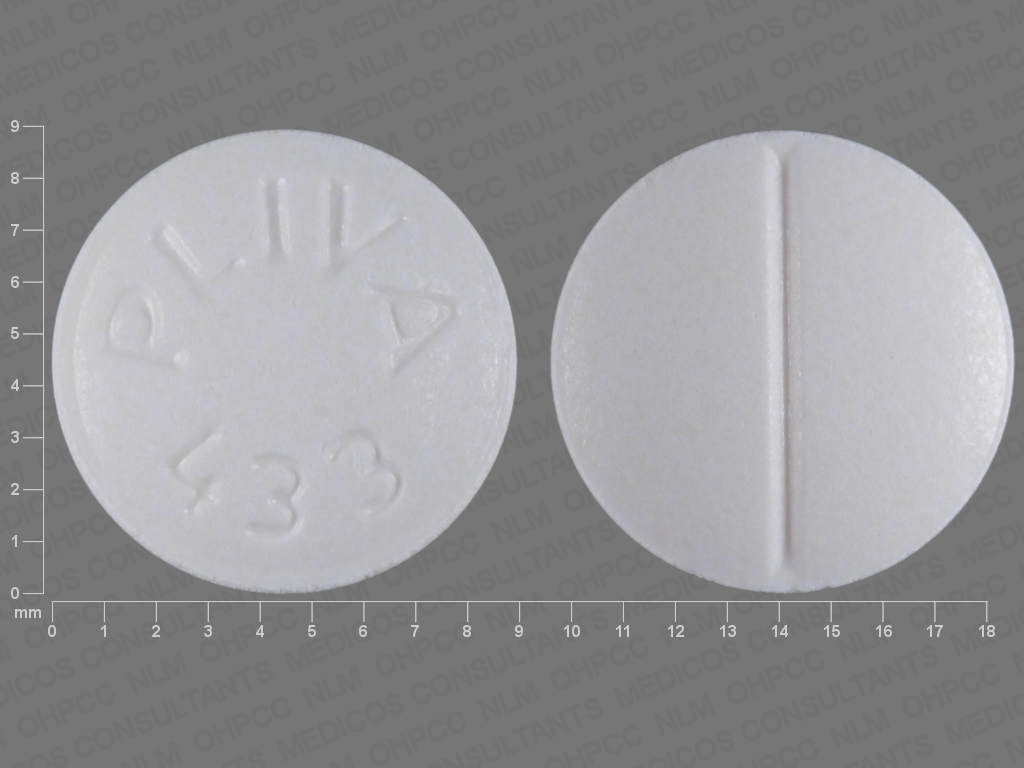 Courtesy of the U.S. National Library of Medicine · Source record · Reuse terms · Archived NLM reference image. Cross-checked against current DailyMed labeling on 2026-08-15. The C3PI/RxIMAGE archive is no longer updated; do not use this image alone to identify an unknown pill. Courtesy of the U.S. National Library of Medicine · Source record · Reuse terms · Archived NLM reference image. Cross-checked against current DailyMed labeling on 2026-08-15. The C3PI/RxIMAGE archive is no longer updated; do not use this image alone to identify an unknown pill. |
| Imprint | PLIVA 433 |
| Drug | Trazodone hydrochloride |
| Strength | 50 mg |
| Color | White |
| Shape | Round |
| Reverse side | Scored |
| Route | Oral |
| Drug class | Antidepressant |
| FDA-approved indication | Major depressive disorder in adults |
| DEA schedule | Not a controlled substance |
| Labeler | Teva Pharmaceuticals; current label notes manufacture in Croatia by Pliva Hrvatska |
What Is PLIVA 433?
PLIVA 433 is one imprint used for a 50 mg immediate-release trazodone hydrochloride tablet. “PLIVA 433” is not the name of the drug or the dose. The active medication is trazodone, and the labeled strength is 50 mg.
Other trazodone strengths can carry related PLIVA imprints. Current DailyMed labeling lists PLIVA 434 for a 100 mg white round tablet and PLIVA 441 for a higher-strength tablet with a different shape and scoring pattern. That makes the full imprint important when identifying a loose medication.
What Is Trazodone?
Trazodone is a serotonergic antidepressant. Current labeling indicates it for the treatment of major depressive disorder in adults. Its effects involve serotonin signaling as well as several receptor systems that can contribute to sedation, dizziness, and changes in blood pressure.
Trazodone has been used in the United States for decades. Unlike alprazolam, zolpidem, eszopiclone, and opioid pain medicines, trazodone is not scheduled as a controlled substance under the Controlled Substances Act.
Is PLIVA 433 a Sleeping Pill?
PLIVA 433 is not FDA-approved specifically as an insomnia medication. The current FDA labeling for trazodone tablets lists major depressive disorder as the approved indication.
However, trazodone is widely prescribed off-label for insomnia because it can be sedating. “Off-label” means a clinician is using an approved medication for a purpose that is not included as an FDA-approved indication in that product’s label. It does not mean that a person should self-treat insomnia with someone else’s trazodone.
Clinical guidelines and reviews have debated the evidence supporting trazodone for chronic insomnia. Someone taking PLIVA 433 for sleep should understand why it was prescribed and follow the clinician’s instructions rather than assuming the pill is simply an over-the-counter-style sleep aid.
Is PLIVA 433 a Controlled Substance?
No. DailyMed explicitly states that trazodone hydrochloride tablets are not a controlled substance.
That does not mean trazodone is risk-free or suitable for sharing. It is a prescription antidepressant with clinically important interactions and adverse effects. “Not controlled” describes its legal scheduling status, not its overall medical risk.
What Is PLIVA 433 Prescribed For?
The FDA-approved use is major depressive disorder in adults. Trazodone can also be prescribed off-label in clinical practice for sleep-related complaints, but that is distinct from its approved indication.
People should not use the 50 mg pill strength to infer what dose is appropriate for depression, sleep, anxiety, or another condition. Trazodone dosing depends on the indication, formulation, other medications, medical conditions, and treatment plan.
Common Side Effects of Trazodone
Current labeling identifies several common adverse reactions, including:
- Drowsiness
- Fatigue
- Dizziness or fainting
- Blurred vision
- Diarrhea
- Nasal congestion
- Edema
Drowsiness and dizziness are especially relevant to people taking trazodone near bedtime. A person can still have impaired thinking, balance, or motor skills and should understand how the medication affects them before driving or doing hazardous work.
PLIVA 433 and Alcohol
Current trazodone medication guidance warns against drinking alcohol or taking other medicines that make a person sleepy or dizzy without discussing it with a healthcare provider. Alcohol can worsen trazodone-related sedation and dizziness.
The fact that trazodone is not a controlled substance does not make mixing it with alcohol harmless.
Serotonin Syndrome
Trazodone can contribute to serotonin syndrome, a potentially life-threatening reaction caused by excessive serotonergic activity. Risk increases when trazodone is combined with other serotonergic drugs or with medications that interfere with serotonin metabolism.
Possible symptoms can include agitation, hallucinations, coordination problems, fast heart rate, sweating, fever, muscle rigidity or abnormal movements, nausea, vomiting, and diarrhea.
A suspected serotonin syndrome requires prompt medical evaluation. People taking trazodone should make sure the prescriber knows about antidepressants, migraine medicines, tramadol, lithium, buspirone, St. John’s wort, and other serotonergic drugs or supplements.
Heart Rhythm and Blood Pressure Risks
Trazodone labeling warns about cardiac arrhythmias, including QT prolongation in susceptible patients, as well as orthostatic hypotension and syncope.
Orthostatic hypotension means blood pressure can fall when a person stands up, leading to dizziness or fainting. This can be especially relevant in older adults, people taking blood-pressure medications, and anyone who has already experienced falls or fainting.
What Is Priapism and Why Is It Mentioned With Trazodone?
Priapism is a prolonged erection that does not resolve normally. It is a rare but well-recognized emergency associated with trazodone.
Current labeling instructs patients to seek emergency medical attention for an erection lasting more than six hours, whether painful or not, because delay can cause permanent damage to erectile tissue.
Suicidal Thoughts and the Antidepressant Boxed Warning
Trazodone carries the antidepressant boxed warning concerning increased risk of suicidal thoughts and behaviors in pediatric and young adult patients in short-term studies. The label instructs clinicians and caregivers to monitor for clinical worsening and new or emerging suicidal thoughts or behaviors.
Trazodone tablets are not approved for use in pediatric patients in the current product label.
Can Trazodone Cause Withdrawal or Discontinuation Symptoms?
Yes. Current labeling recommends gradually reducing trazodone rather than abruptly stopping whenever possible because discontinuation symptoms can occur.
Reported discontinuation symptoms can include anxiety, agitation, sleep problems, and other symptoms. The appropriate reduction depends on the person’s treatment and should be discussed with the prescriber rather than based on a generic online schedule.
Can You Overdose on PLIVA 433?
Yes. Trazodone overdose can be serious. Current labeling reports severe reactions including seizures, respiratory arrest, ECG changes such as QT prolongation, and other complications. Deaths have also occurred when trazodone was taken with other central nervous system depressants.
Someone who may have taken too much trazodone, is difficult to wake, has a seizure, faints, develops an abnormal heartbeat, or has other severe symptoms needs urgent medical evaluation.
Is PLIVA 433 Addictive?
Trazodone is not a controlled substance, and current labeling states that clinical studies did not show a pattern of drug-seeking behavior. That is different from saying a person can never misuse it or that abrupt discontinuation is always comfortable.
A person taking trazodone primarily to intensify sedation, mixing it with other substances, or using medication that was not prescribed to them should discuss that pattern with a clinician.
PLIVA 433 vs. PLIVA 434
| PLIVA 433 | Trazodone hydrochloride 50 mg; white round tablet |
| PLIVA 434 | Trazodone hydrochloride 100 mg; white round tablet |
| Key difference | Strength and imprint |
| Drug class | Both are trazodone antidepressant tablets |
| Controlled status | Neither is federally controlled |
Because the tablets can share color and shape, the final digits in the imprint matter. A person should not assume one white PLIVA tablet has the same strength as another.
Can PLIVA 433 Be Counterfeit?
Any prescription pill obtained outside normal pharmacy channels can be counterfeit. FDA warns that counterfeit medicines may contain the wrong ingredients, incorrect amounts, no active drug, or harmful contaminants.
If a trazodone tablet from a legitimate prescription unexpectedly looks different, contact the pharmacy. If a loose tablet came from an unknown source, do not use an imprint match as proof of authenticity.
Frequently Asked Questions About PLIVA 433
What pill is PLIVA 433?
PLIVA 433 is trazodone hydrochloride 50 mg, a white round prescription antidepressant tablet.
Is PLIVA 433 a sleeping pill?
Trazodone is frequently prescribed off-label for insomnia, but its current FDA-approved tablet indication is major depressive disorder in adults.
Is PLIVA 433 Xanax?
No. Xanax contains alprazolam, a benzodiazepine. PLIVA 433 contains trazodone, an antidepressant.
Is PLIVA 433 controlled?
No. DailyMed states that trazodone hydrochloride tablets are not a controlled substance.
Can you drink alcohol with trazodone?
Trazodone labeling warns that alcohol can worsen sleepiness and dizziness. Patients should discuss alcohol use with the prescribing clinician.
Can trazodone cause serotonin syndrome?
Yes. The risk is higher when trazodone is combined with other serotonergic medicines or substances.
Does trazodone have withdrawal symptoms?
Discontinuation symptoms can occur, and current labeling recommends gradually reducing the medication rather than abruptly stopping whenever possible.
Sources
- DailyMed — Trazodone Hydrochloride / PLIVA 433: Current 2025 PLIVA 433 identification, MDD indication, warnings, adverse effects, interactions and controlled-substance status.
- NCBI Bookshelf — Trazodone: Clinical review of trazodone and its common off-label use for insomnia.
- Journal of Clinical Sleep Medicine — Pharmacologic Treatment of Chronic Insomnia: Guideline context on trazodone use for chronic insomnia.
- FDA — Counterfeit Medicine: Counterfeit-medicine safety information.
About This Article
Editorial standard
Rehabs.Today resource articles are written for educational and treatment-navigation purposes. For medical and drug-safety claims, we prioritize current primary or authoritative references such as FDA and DailyMed labeling, CDC, SAMHSA, NIH/NCBI resources, and peer-reviewed research when appropriate. Important limitations, uncertainty, and differences between population-level evidence and individual medical advice are stated where they matter.
How to use this information
This article provides general educational information. It is not a diagnosis, prescription, personalized taper, or substitute for advice from a physician, pharmacist, or other qualified healthcare professional. Do not start, stop, combine, or change a prescribed medication solely because of information on this page.
Emergency information
If someone cannot be awakened, is breathing slowly or abnormally, or may be experiencing an opioid overdose, seek emergency medical help immediately and give naloxone if it is available.
Treatment-directory transparency
Some Rehabs.Today articles link to treatment directories and provider resources. Those links are for navigation and do not replace independent medical assessment. Medical claims in the article should be evaluated from the cited evidence, not from whether a treatment provider is linked.