For immediate-release Xanax (alprazolam), the noticeable therapeutic effect usually lasts for several hours, while the drug remains in the body much longer. In a clinical study of people with panic disorder, conventional alprazolam had a mean duration of therapeutic action of about 5.1 hours, while extended-release alprazolam averaged about 11.3 hours. These figures describe one study population, so they should not be treated as a personal dosing schedule.
The FDA-approved prescribing information gives alprazolam a mean elimination half-life of about 11.2 hours in healthy adults, with a reported range of 6.3 to 26.9 hours. That is why a person can feel that Xanax has worn off while a meaningful amount of alprazolam is still present in the body.
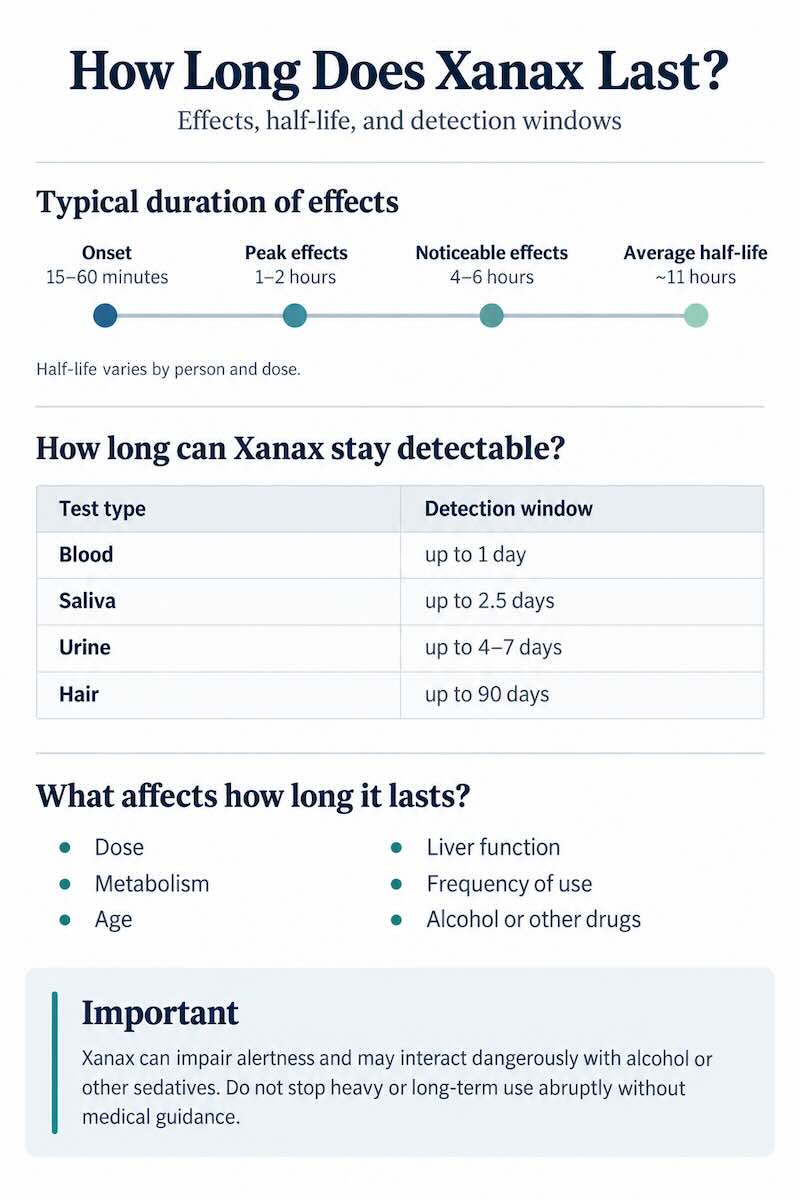
How Long Does Xanax Last at a Glance?
| Active drug | Alprazolam |
| When blood levels peak | About 1 to 2 hours after an oral dose |
| Immediate-release therapeutic duration | Several hours; one panic-disorder study reported a mean of about 5.1 hours |
| Extended-release therapeutic duration | Longer and steadier; the same study reported a mean of about 11.3 hours |
| Mean elimination half-life | About 11.2 hours in healthy adults |
| Does the drug remain after the effects fade? | Yes |
| Can repeated doses overlap? | Yes |
| Does half-life tell you when it is safe to drive or take another dose? | No |
Why the Effect of Xanax and Its Half-Life Are Different
Xanax begins changing brain activity before the body has finished absorbing the dose. Alprazolam enhances signaling at GABA-A receptors, which reduces nervous-system activity and can produce anxiety relief, sedation, slowed reaction time and impaired coordination. Blood concentrations generally reach their peak about one to two hours after an oral dose.
The effect a person notices can begin to fade several hours later, but elimination continues much more slowly. A half-life of 11.2 hours means that the blood concentration falls by about half over that period on average. It does not mean that the medication suddenly stops working at 11.2 hours, and it does not mean that the entire dose has left the body.
This difference explains a common experience with short-acting benzodiazepines. Someone may feel their anxiety returning and assume that no alprazolam remains, even though the previous dose has only partly cleared. If another prescribed dose is taken while alprazolam from an earlier dose is still present, the exposures overlap.
That overlap is expected when a medication is used according to a prescribed schedule, but it becomes clinically important when someone begins taking extra doses because the previous dose feels weaker or seems to wear off sooner. The amount a person feels and the amount still circulating are related, but they are not interchangeable measurements.
How Long Does Immediate-Release Xanax Work?
Immediate-release alprazolam is absorbed relatively quickly. In one clinical study involving people with panic disorder, conventional alprazolam produced a mean therapeutic duration of about 5.1 hours. Individual responses varied, and the study should not be used to predict exactly when a specific dose will stop affecting a particular person.
Several factors influence what “lasting” means in practice. Anxiety relief may fade before drowsiness or slowed reaction time disappears. A person who has developed tolerance may notice less sedation even though alprazolam concentrations remain significant. Someone taking other central nervous system depressants may remain impaired longer than expected because the combined effects are stronger than alprazolam alone.
The dose strength also does not create a simple clock. A 0.25 mg, 0.5 mg or 1 mg tablet contains a different amount of alprazolam, but the duration of noticeable effects still depends on absorption, metabolism, tolerance, other medications and the reason the drug is being taken. Tablet strength should not be converted into a self-directed redosing interval.
Does Xanax XR Last Longer Than Regular Xanax?
Xanax XR contains the same active drug, alprazolam, but releases it more gradually. The extended-release formulation produces a slower concentration profile that is intended to reduce the rise and fall seen with immediate-release tablets.
In the panic-disorder study comparing the two formulations, mean therapeutic action lasted about 11.3 hours with extended-release alprazolam compared with about 5.1 hours for conventional alprazolam. The elimination of alprazolam itself is similar once the drug has entered circulation, so the longer clinical profile comes mainly from the slower release and absorption pattern.
People comparing the two formulations can read the separate Xanax XR vs Xanax guide for the differences in release pattern and clinical use.
Why Xanax Lasts Longer in Some People
The 11.2-hour half-life is an average from healthy adults, and the prescribing information documents substantial variation. In healthy older adults, the mean half-life was about 16.3 hours. In a group of people with obesity, it averaged about 21.8 hours, while people with alcoholic liver disease had a mean half-life of about 19.7 hours.
These averages do not predict one person’s exact clearance time. They show why age, body composition and liver function can change exposure enough that two people taking the same strength tablet may have different concentration profiles and different degrees of residual impairment.
Drug interactions can change the timeline as well. Alprazolam is metabolized primarily through CYP3A4. Medications that inhibit this pathway can increase alprazolam exposure, while inducers can reduce it. Alcohol, opioids, sleep medications and other sedating drugs can also increase functional impairment even when they do not extend alprazolam’s chemical half-life.
When Xanax Feels Like It Is Wearing Off Between Doses
For someone who has developed physical dependence, the return of anxiety between doses can have more than one explanation. The original anxiety disorder may be re-emerging as the medication effect fades, but falling alprazolam concentrations can also contribute to interdose withdrawal. In some people, both processes are occurring at the same time.
Timing becomes useful here. Anxiety, tremor, insomnia, agitation or other symptoms that repeatedly emerge as a dose wears off and improve after the next dose can give a clinician information about dependence and concentration fluctuation. That pattern still cannot diagnose withdrawal by itself, because the same symptoms can occur with panic and anxiety disorders.
Physical dependence also needs to be separated from addiction. A person can become physically dependent on a benzodiazepine while taking it as prescribed. Addiction involves a broader pattern of impaired control and continued use despite harm. The distinction affects what kind of treatment is appropriate.
If regular Xanax use has led to physical dependence, abrupt discontinuation can cause severe withdrawal, including seizures. FDA warnings and the current ASAM benzodiazepine tapering guideline recommend gradual, individualized dose reduction under clinical supervision rather than using half-life calculations to design a taper at home.
Residual Xanax Can Still Affect Driving, Coordination and Judgment
Feeling less anxious or less sedated does not establish that reaction time and coordination have fully returned. Alprazolam can impair alertness, judgment and motor performance, and those effects become harder to predict when sleep deprivation or other sedating substances are involved.
Alcohol and opioids are especially important because they also depress the central nervous system. Combining benzodiazepines with opioids can cause profound sedation and respiratory depression, and the FDA requires a boxed warning about the risk of coma and death. Alcohol can also intensify drowsiness, poor coordination and other central nervous system effects.
A half-life estimate cannot determine a safe driving time. The same is true of a drug-test result. A test may remain positive after the strongest subjective effects have faded, while a person can still be impaired before a particular test detects or reports a drug.
How Long Does Xanax Stay in Your System?
Drug elimination and drug-test detection are separate questions from how long Xanax feels active. Because alprazolam has a mean half-life of about 11.2 hours and individual half-lives vary widely, the parent drug and its metabolites can remain in the body after the most noticeable effects have passed.
Urine, blood, saliva and hair testing also have different detection windows. Those windows depend on the test, specimen, dose pattern and individual metabolism. The separate guide to how long Xanax stays in your system covers detection rather than repeating that material here.
Counterfeit Xanax Does Not Follow the Alprazolam Timeline
The timelines above apply to known alprazolam. A pill sold as Xanax outside a licensed pharmacy cannot be assumed to contain alprazolam at the stated strength, or to contain alprazolam at all. FDA warnings about counterfeit medicine note that fake pills can contain the wrong active ingredient, too much or too little of an ingredient, no active drug, or other harmful substances.
Counterfeit tablets sold as Xanax have been found with fentanyl and with other benzodiazepine-type drugs. Their onset, duration and overdose risk can therefore differ completely from pharmaceutical alprazolam.
Severe sleepiness, slow or shallow breathing, inability to stay awake, loss of consciousness or blue or gray lips are emergency signs. Call emergency services immediately. If opioid exposure is possible and naloxone is available, it can be used while emergency help is on the way. A response to naloxone suggests that an opioid may be involved; it does not establish what else was or was not present in the pill.
When Duration Becomes a Dependence or Treatment Question
For someone taking Xanax exactly as prescribed, questions about duration are often practical medication questions. The situation changes when a person begins taking extra doses to prevent discomfort, feels unable to get through the interval between doses, repeatedly runs out early, combines Xanax with alcohol or other drugs, or has tried to stop and developed withdrawal symptoms.
Those patterns can justify a clinical assessment of physical dependence, substance use disorder, co-occurring anxiety and withdrawal risk. The appropriate next step depends on what is happening. Some people need a supervised medication taper. Others need withdrawal management, ongoing addiction treatment, psychiatric care, or a combination of these services.
Withdrawal management also does not replace treatment for a substance use disorder when one is present. Stabilizing the immediate withdrawal risk addresses one part of the problem, while ongoing care may need to address compulsive use, co-occurring mental health symptoms, other substances and the conditions that keep the pattern going.
Frequently Asked Questions About How Long Xanax Lasts
How long does it take Xanax to kick in?
Alprazolam is absorbed quickly, and blood concentrations generally peak about one to two hours after an oral dose. A person may begin noticing effects before the concentration reaches its peak.
How long do the effects of Xanax last?
Immediate-release Xanax generally has noticeable therapeutic effects for several hours. One study in people with panic disorder reported a mean therapeutic duration of about 5.1 hours for conventional alprazolam, although individual duration varies.
What is the half-life of Xanax?
The FDA-approved prescribing information reports a mean alprazolam half-life of about 11.2 hours in healthy adults, with a range of 6.3 to 26.9 hours.
Does Xanax stop working after one half-life?
No. Half-life describes how quickly the concentration falls. It does not define the exact end of anxiety relief, sedation, impairment or withdrawal protection.
How long does 0.25 mg, 0.5 mg or 1 mg of Xanax last?
There is no reliable duration that can be assigned to a tablet strength alone. Dose affects exposure, but age, liver function, tolerance, formulation, other medications and repeated dosing also influence how long effects and impairment may last.
Can Xanax build up when it is taken repeatedly?
Yes. A new dose can be taken while alprazolam from earlier doses is still present. This is one reason prescribed dose timing should not be changed using a half-life calculation.
Can withdrawal begin while Xanax is still in the body?
Yes. In a physically dependent person, symptoms can emerge as alprazolam concentrations fall even though the drug has not been completely eliminated. Recurrent anxiety and interdose withdrawal can also overlap.
Does Xanax XR last longer than regular Xanax?
Xanax XR releases alprazolam more gradually and produces a longer therapeutic profile than immediate-release alprazolam. The active drug is still alprazolam, so the difference comes mainly from how the formulation releases and absorbs the medication.
Sources
- DailyMed: Alprazolam Prescribing Information: absorption, peak concentration, metabolism, mean half-life, half-life range and special-population pharmacokinetics.
- PubMed: The Speed of Onset of Action of Alprazolam-XR Compared to Alprazolam-CT in Panic Disorder: study-specific comparison of therapeutic duration for conventional and extended-release alprazolam.
- FDA: Benzodiazepine Boxed Warning: abuse, misuse, addiction, physical dependence, withdrawal and risks with opioids and other central nervous system depressants.
- ASAM: Joint Clinical Practice Guideline on Benzodiazepine Tapering: individualized tapering and withdrawal-risk management.
- FDA: Counterfeit Medicine: risks from falsified medications and unknown ingredients.
About This Article
Editorial standard
Rehabs.Today resource articles are written for educational and treatment-navigation purposes. For medical and drug-safety claims, we prioritize current primary or authoritative references such as FDA and DailyMed labeling, CDC, SAMHSA, NIH/NCBI resources, and peer-reviewed research when appropriate. Important limitations, uncertainty, and differences between population-level evidence and individual medical advice are stated where they matter.
How to use this information
This article provides general educational information. It is not a diagnosis, prescription, personalized taper, or substitute for advice from a physician, pharmacist, or other qualified healthcare professional. Do not start, stop, combine, or change a prescribed medication solely because of information on this page.
Emergency information
If someone cannot be awakened, is breathing slowly or abnormally, or may be experiencing an opioid overdose, seek emergency medical help immediately and give naloxone if it is available.
Treatment-directory transparency
Some Rehabs.Today articles link to treatment directories and provider resources. Those links are for navigation and do not replace independent medical assessment. Medical claims in the article should be evaluated from the cited evidence, not from whether a treatment provider is linked.