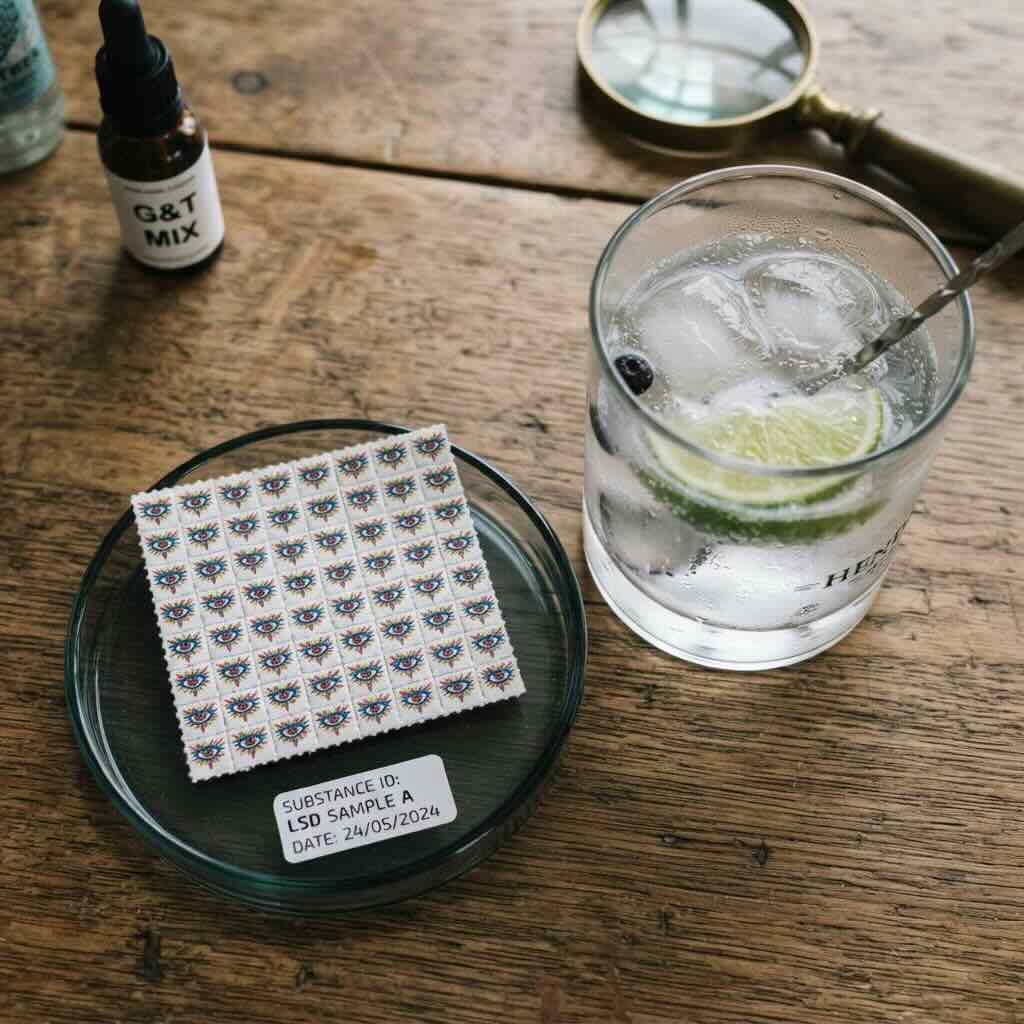
LSD and alcohol does not reliably stop an LSD trip, and combining the two can make impairment harder to judge. The best-known human interaction study is small and retrospective: among LSD users who had also consumed alcohol, most reported feeling less of alcohol’s subjective effects. That finding does not show that blood alcohol concentration, coordination, judgment or reaction time returned to normal.
LSD can distort perception, time estimation and risk assessment. Alcohol independently impairs balance, memory, judgment and coordination. When both are present, a person may feel less obviously drunk while still being impaired by alcohol and simultaneously experiencing psychedelic effects.
The evidence base for LSD and alcohol co-use is limited. There is no validated amount of alcohol that can be considered safe during an LSD experience and no evidence-based waiting-time formula that determines when drinking becomes risk-free after LSD.
LSD and Alcohol at a Glance
| Does alcohol stop LSD? | No reliable evidence supports alcohol as a way to terminate an LSD trip |
| Can LSD change how drunk someone feels? | Small retrospective human research found diminished subjective alcohol effects in LSD users |
| Does feeling less drunk mean less impairment? | No. Subjective feeling does not establish normal coordination, judgment or blood alcohol concentration |
| Main combined risks | Impaired judgment, poor coordination, memory problems, accidents, vomiting, panic and difficult emergency assessment |
| Can both affect driving? | Yes. Both can impair abilities needed for safe driving |
| Major emergency signs | Inability to wake, abnormal breathing, seizure, severe injury, collapse or dangerous behavior |
| Is there a safe drink-count rule? | No validated universal threshold exists for LSD and alcohol co-use |
Does Alcohol Stop an LSD Trip?
Alcohol is not a validated treatment for LSD intoxication or a bad trip. It does not have an established role as an antidote to LSD, and there is no clinical evidence that drinking alcohol reliably ends LSD’s psychedelic effects.
A person may feel calmer, more sedated or less aware of parts of the experience after drinking. Those subjective changes can be mistaken for the trip ending. Alcohol still adds its own impairment and can make the situation more difficult to monitor.
When a person is frightened during LSD intoxication, the safer response is to reduce environmental stimulation, move away from hazards and obtain medical help if the person cannot remain safe. LSD Bad Trip covers supportive response and emergency thresholds.
Why LSD Can Make Someone Feel Less Drunk
A small human study published in 2000 used retrospective structured interviews with people who had combined alcohol with LSD or another classic psychedelic. Among participants who had used LSD and alcohol together, most reported a marked reduction in the subjective feeling of alcohol intoxication.
The study was based on self-report and involved a very small group. It did not establish that LSD lowered blood alcohol concentration or restored psychomotor function.
This creates an important practical problem. A person can feel less sedated or less obviously intoxicated and conclude that more alcohol is tolerable, even though alcohol remains in the body and continues to affect balance, memory, judgment and reaction time.
Current reviews of classic psychedelic interactions continue to describe the LSD-alcohol evidence base as limited. The subjective interaction should therefore be treated as an observation, not a protective effect.
Judgment and Coordination Can Be Impaired in Different Ways
LSD and alcohol affect behavior through different mechanisms. LSD can alter visual perception, time estimation, emotional salience and the interpretation of risk. Alcohol makes it harder for brain systems involved in balance, memory, speech and judgment to function normally.
Those effects can overlap in ways that are difficult to recognize from the outside. Someone may walk poorly because of alcohol, misjudge distance because of LSD, or take an unsafe action because both judgment and perception are impaired.
Confidence can also become misleading. LSD can produce a feeling of unusual clarity, significance or reduced fear, while alcohol lowers inhibition. A person may therefore feel capable of doing something that requires intact coordination and decision-making when neither is reliable.
LSD and Alcohol Can Increase Accident Risk
Alcohol is associated with motor vehicle crashes, falls, drownings and other injuries. LSD can independently create accident risk by altering depth perception, time perception and ordinary danger recognition.
Combining the two can make hazards harder to judge. Roads, balconies, water, stairs, fires and moving machinery become particularly concerning when coordination and perception are both altered.
A person should not drive because the visual effects seem mild or because they feel less drunk than expected. Subjective alertness does not demonstrate safe reaction time, judgment or coordination.
Can Alcohol Prevent or Worsen a Bad Trip?
There is no evidence that alcohol reliably prevents a bad LSD trip. Alcohol may initially feel calming, but it can also increase disinhibition, reduce memory and impair decision-making during an already altered mental state.
A frightened person may become more impulsive, more difficult to redirect or less able to remember how much alcohol or other drugs have been taken.
LSD reactions are strongly influenced by psychological state and environment. Adding another intoxicant introduces another variable into an experience that may already be unstable.
Severe panic, suicidal behavior, violent agitation or inability to remain physically safe requires appropriate medical or emergency assessment instead of additional alcohol.
Vomiting and Reduced Consciousness Change the Emergency Risk
Alcohol intoxication can progress from impaired judgment and coordination to vomiting, stupor, loss of consciousness and life-threatening suppression of breathing and other vital functions.
Someone who is vomiting while severely intoxicated can choke, especially if consciousness is reduced. An unconscious person should not be left alone.
Deep unresponsiveness and slow or irregular breathing are not characteristic of uncomplicated LSD intoxication. When those signs appear after LSD and alcohol use, alcohol poisoning, opioids, sedatives or another medical problem must be considered.
Call emergency services for inability to wake, slow or irregular breathing, seizure, collapse, blue or pale skin, severe injury or repeated vomiting with reduced consciousness.
Other Drugs Can Change the LSD-Alcohol Risk Quickly
LSD and alcohol are often used in broader polysubstance settings. Cannabis, stimulants, benzodiazepines, opioids and other substances can substantially change the clinical picture.
Opioids and sedative drugs are especially important when consciousness or breathing is impaired. Naloxone does not reverse LSD or alcohol, but it should be used when opioid exposure may be contributing to abnormal breathing or unresponsiveness.
Stimulants can increase arousal and cardiovascular stress. Cannabis can intensify anxiety or perceptual changes in some people. Sedatives can deepen impairment and make it harder to distinguish a bad trip from an overdose.
Heavy Alcohol Use Changes the Withdrawal Question
LSD is not associated with a classic physical withdrawal syndrome. Alcohol can produce severe withdrawal after physical dependence develops.
A person who has been drinking heavily and regularly may develop tremor, agitation, hallucinations, seizures or delirium when alcohol exposure falls. Those symptoms require medical attention and should not be attributed to an LSD comedown.
LSD Withdrawal explains why post-LSD fatigue and anxiety differ from alcohol, benzodiazepine or opioid withdrawal.
Is There a Safe Number of Drinks With LSD?
No validated drink-count rule exists for LSD and alcohol co-use. Alcohol concentration differs across beverages, individual alcohol response varies and LSD effects are also highly variable.
The limited interaction literature cannot establish that one drink, two drinks or any other fixed amount is universally safe during a psychedelic experience.
Using a fixed number would imply a level of precision that the evidence does not provide. The absence of obvious intoxication is also not a reliable safety measure because the person may perceive alcohol effects differently while using LSD.
How Long After LSD Is Alcohol Safe?
There is no evidence-based waiting-time formula for alcohol after LSD. Acute LSD effects commonly last many hours, and fatigue, altered judgment or sleep disruption can remain after the strongest visual effects decline.
Alcohol metabolism depends on the amount consumed, individual physiology and the timing of drinking. LSD’s half-life cannot be converted into a personal drinking calculator.
A person who is still experiencing perceptual changes, confusion, significant anxiety, impaired judgment or severe sleep deprivation remains poorly positioned to assess alcohol-related impairment.
LSD Research for Alcohol Use Disorder Is a Different Situation
LSD has been studied experimentally in alcohol use disorder. Historical randomized trials and later systematic reviews have examined whether psychedelic-assisted interventions can reduce harmful drinking.
Those studies do not support recreational mixing of LSD and alcohol. Clinical research uses screening, known substances, measured administration, supervision and structured psychological support.
Research into LSD as a treatment for alcohol problems asks whether a supervised psychedelic intervention can influence later drinking behavior. It does not involve using alcohol to manage an LSD experience.
When Both LSD and Alcohol Are Part of a Repeated Pattern
Repeated co-use deserves assessment of both substances. Alcohol can become physically dependence-forming, while problematic hallucinogen use can involve repeated risky use, impaired control and continued exposure despite psychiatric or social consequences.
Useful questions include how often the person drinks, whether blackouts occur, whether alcohol is used to start or end trips, whether frightening LSD experiences have repeated and whether injuries or emergency visits have occurred.
When alcohol use disorder is present, evidence-based care may include medication and behavioral treatment. Hallucinogen-related treatment focuses more on behavior, psychiatric symptoms and associated substance use.
Depending on severity, care may include detox services, residential treatment or dual-diagnosis treatment.
What to Do if LSD and Alcohol Were Already Mixed
Do not add more substances in an attempt to balance the effects. Move away from traffic, heights, water, weapons and other immediate hazards.
Stay with a severely impaired person and monitor responsiveness and breathing. If the person is vomiting, reduced consciousness increases choking risk.
Seek emergency help for seizure, collapse, serious injury, suicidal or violent behavior, inability to wake, slow or irregular breathing, blue or pale skin or any condition in which basic safety cannot be maintained.
Tell emergency responders that LSD, alcohol and any other known or possible substances were involved. The actual product sold as LSD may also be uncertain.
Frequently Asked Questions About LSD and Alcohol
Does alcohol stop LSD?
No. Alcohol is not an established antidote or validated way to end an LSD experience.
Can LSD make you feel less drunk?
Small retrospective human research found that many LSD users reported diminished subjective alcohol effects. That does not prove blood alcohol concentration or impairment was reduced.
Is mixing LSD and alcohol safe?
There is no evidence supporting a universally safe combination. Both can impair judgment, and alcohol adds coordination, memory and overdose risks.
Can you drink alcohol to calm a bad trip?
Alcohol is not a validated treatment for a bad trip and can add disinhibition, confusion and impairment.
Can LSD and alcohol cause blackouts?
Alcohol can cause memory blackouts at higher intoxication levels. LSD can also make events difficult to interpret or remember, so combined intoxication can complicate the history further.
When should emergency services be called?
Call for inability to wake, abnormal breathing, seizure, collapse, severe injury, dangerous behavior or repeated vomiting with reduced consciousness.
Does naloxone work on LSD and alcohol?
Naloxone does not reverse LSD or alcohol. It is appropriate when an opioid may also be contributing to abnormal breathing or unresponsiveness.
Is LSD used to treat alcohol addiction?
LSD has been studied experimentally in alcohol use disorder under controlled research conditions. That research does not support recreational LSD-and-alcohol co-use.
Sources
- Barrett et al.: Hallucinogenic Drugs Attenuate the Subjective Response to Alcohol in Humans: small retrospective structured-interview study of classic psychedelics and perceived alcohol effects.
- Thomas: Toxicology and Pharmacological Interactions of Classic Psychedelics: 2026 review of psychedelic toxicology and drug interactions.
- NIAAA: Alcohol and the Brain: effects of alcohol on balance, memory, speech and judgment.
- CDC: Alcohol Use and Your Health: short-term injury and alcohol-poisoning risks.
- DEA: LSD Drug Fact Sheet: current federal information on LSD, altered perception and impaired judgment.
- Classic Psychedelics and Alcohol Use Disorders: Systematic Review: clinical and preclinical research on psychedelics and alcohol use disorder.
About This Article
Editorial standard
Rehabs.Today resource articles are written for educational and treatment-navigation purposes. For medical and drug-safety claims, we prioritize current primary or authoritative references such as FDA and DailyMed labeling, CDC, SAMHSA, NIH/NCBI resources, and peer-reviewed research when appropriate. Important limitations, uncertainty, and differences between population-level evidence and individual medical advice are stated where they matter.
How to use this information
This article provides general educational information. It is not a diagnosis, prescription, personalized taper, or substitute for advice from a physician, pharmacist, or other qualified healthcare professional. Do not start, stop, combine, or change a prescribed medication solely because of information on this page.
Emergency information
If someone cannot be awakened, is breathing slowly or abnormally, or may be experiencing an opioid overdose, seek emergency medical help immediately and give naloxone if it is available.
Treatment-directory transparency
Some Rehabs.Today articles link to treatment directories and provider resources. Those links are for navigation and do not replace independent medical assessment. Medical claims in the article should be evaluated from the cited evidence, not from whether a treatment provider is linked.